Toyota Unites European and South African Gazoo Racing Teams for 2027 Dakar Rally
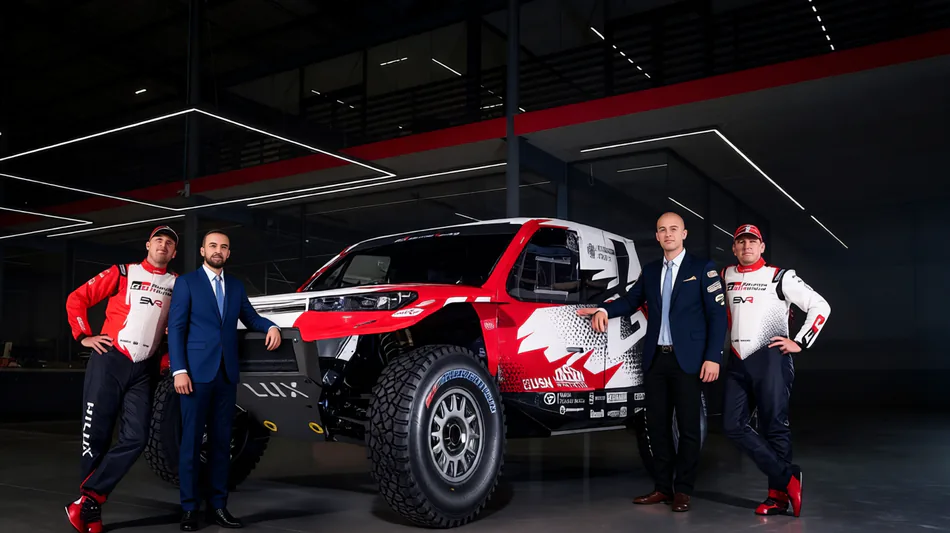
Toyota has announced that its European and South African motorsport divisions will merge into a single team structure to compete in the 2027 Dakar Rally. The Japanese manufacturer will deploy five crews in the Ultimate category using the new Hilux DKR Alpha, alongside an experimental hydrogen-powered prototype in the Mission 1000 class.
Toyota has confirmed that its Gazoo Racing Europe and Gazoo Racing South Africa divisions will operate under a unified team structure for the 2027 Dakar Rally. The Japanese manufacturer will field five crews in the Ultimate category using the new Hilux DKR Alpha, while also entering an experimental hydrogen fuel-cell-powered vehicle in the Mission 1000 class.
The 49th edition of the rally is scheduled to take place from January 9 to 23. The route will span 7,824 kilometers across 12 stages, including 4,341 kilometers of competitive sections, traveling from Portugal to Morocco. The event’s relocation from Saudi Arabia was driven by security concerns related to the conflict in the Middle East, marking its return to Africa for the first time since 2007. Saudi Arabia is scheduled to host the rally again in 2028.
The five Ultimate category crews will compete in the all-new Hilux DKR Alpha, a vehicle based on the ninth-generation production model. While retaining the Hilux name and design cues, the competition cars utilize a lightweight tubular chassis equipped with dedicated suspension, dampers, and brakes designed for high-speed off-road demands. Power is supplied by an engine derived from Toyota’s 3.5-liter V35A twin-turbocharged V6 petrol unit, with output and efficiency adapted specifically for rally-raid competition.
The driver lineup features a mix of experienced veterans and rising talent. South Africans Henk Lategan and Brett Cummings, who finished second overall at the 2025 Dakar Rally, will drive together. The pair are multiple South African national champions and won the South African round of the World Rally-Raid Championship (W2RC) in 2025.
Also competing are fellow South Africans Guy Botterill and Henry Köhne. Botterill, the reigning 2026 South African Rally-Raid champion, finished sixth overall on his Dakar debut in 2024 and was named rookie of the year. This will be Köhne’s first Dakar appearance alongside him.
The remaining three crews include Japanese driver Akira Miura and Spanish navigator Armand Monleón; Americans Seth Quintero and Andrew Short; and South Africans Saood Variawa and Charan Moore. Miura is a five-time winner of the Dakar’s Stock category, having previously competed in a Toyota Land Cruiser, while Monleón has 11 Dakar appearances to his name.
Quintero and Short arrive with two W2RC victories in 2026 and multiple Dakar stage wins. Quintero finished second in the T3 category in 2023 and will be aiming for his first overall podium. Variawa became the youngest driver to win a Dakar stage when he claimed victory during his second appearance in 2025 at the age of 21. The 2025 South African Rally-Raid champion will be partnered by former motorcycle competitor Moore, who takes on the navigator role.
In addition to the petrol-powered entries, Toyota will enter the DKR GR FC Hilux in the Dakar Future Mission 1000 category, which is dedicated to experimental vehicles and alternative propulsion technologies. The vehicle uses hydrogen fuel-cell technology to generate electricity for its drivetrain. Toyota stated that the development involved its European R and D centre, Overdrive Racing, Toyota Racing GmbH in Cologne, and its Hydrogen Factory in Japan.
The DKR GR FC Hilux shares its underlying platform with the Ultimate-class vehicle, including its tubular frame, safety cell, suspension, and braking systems. Its fuel-cell system comprises two production fuel-cell stacks combined into a single high-powered unit. Gaseous hydrogen is stored in tanks derived from those used in the Toyota Mirai production car.
Other dedicated components include an electric axle, an IAV Dragoon electronic control unit (ECU), and a new electronics system. Toyota has also incorporated a high-voltage cooling system and natural fibre body panels, replacing some of the carbon fibre components typically used in such builds.
Saudi Arabian driver Dania Akeel and French navigator Sébastien Delaunay will pilot the experimental Hilux, contesting the Dakar together for the second time. Akeel made her Dakar debut in 2022, finishing in the top 10 of the T3 category. She subsequently won a stage in the Challenger category in 2025 and is a two-time winner of the FIA Middle East Baja Cup.
Toyota described the project as part of its broader effort to use motorsport to develop technologies for future production vehicles.
F.Herzog--BP