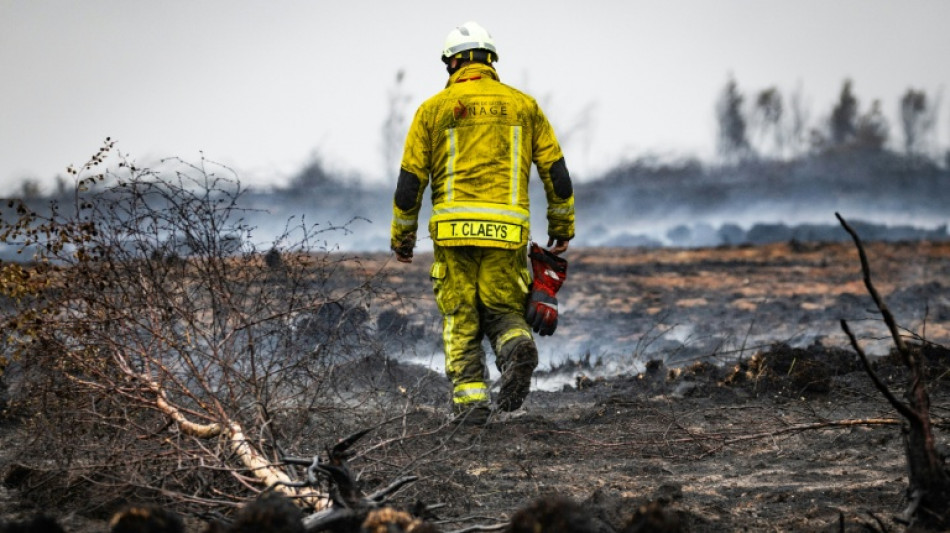
Belgian fire of the century 'encircled' but fight goes on / Photo: © Belga/AFP
Firefighters hacked their way through boggy terrain overnight to fully surround Belgium's largest wildfire in a century, but crews were still battling numerous flare-ups in the High Fens nature reserve.
Crisis cell spokesman Tony Hosmans told AFP the fire burning since Friday "has been contained and should no longer be able to spread" -- after threatening to spill over the German border to the east.
"But the affected area is extremely large and there are numerous flare-ups that we need to combat both on the ground and from the air," he cautioned.
The blaze charring the expanse of peatland, pine trees and hiking trails grew over the weekend to half the size of Manhattan -- 3,000 hectares (7,500 acres) -- although hundreds of firefighters working night and day managed to stop it spreading further.
Hosmans said the new flare-ups were being "brought under control" as they emerged, with Wednesday's goal to finally tame the fire -- if possible with aerial support
Water-bombing aircraft flown in from Norway, Germany, Sweden and the Netherlands have been grounded by low clouds, and the local governor's office said it "remains to be confirmed" whether they would be able to deploy.
On-site operations have been complicated by the fens' terrain -- a patchwork of heath, peat bogs and raised wooden boardwalks.
The last area to be circumscribed was a hard-to-access front closest to the German border, with ground crews working all night to close the gap, coming in from the east and north under very difficult conditions.
- Zombie fire -
Europe has been swept by weeks of devastating wildfires fuelled by dry conditions and a historically hot summer, with France, Greece, Portugal and Spain also battling major blazes.
The High Fens blaze broke out for reasons still unknown in an area that was ravaged by massive fires in 1911, during a similar period of heatwaves.
It is the country's largest wildfire since.
The fire triggered evacuation orders in the German border town of Monschau as well as two Belgian villages, although residents of the hamlet of Sourbrodt have been given the green light to return home.
Even once brought under control, officials have warned it will take weeks or even months of soaking and dousing to prevent the fire from reigniting.
"The fire is burning in the peat, so it is actually underground, sometimes quite deep," explained area fire chief David Covens on a trip into the fire zone.
In peatland terrain like the High Fens, a fire can smoulder underground and resurface some distance away, a phenomenon known as a "zombie fire" that can also attack tree roots, increasing the risk of them collapsing.
"At first glance, it may seem under control, but it can flare up again because it re-emerges, sometimes from great depths," explained regional government spokesperson Stephanie Ernoux.
To detect flare-ups more effectively, firefighters were using drones equipped with heat-sensing detectors, she said.
In forests, peat is an accumulation of spongy, highly flammable, carbon-rich material formed over time through the decomposition of plant matter.
It is an ideal fuel for buried embers, which can lie dormant until favourable conditions, such as wind and dry weather, allow them to reignite in broad daylight.
"Whenever we disturb the ground, when we cut down a tree and expose the soil, the fire can reignite," said fire chief Covens.
"We're doing everything we can with the resources available, but we know this is going to take a long time."
W.Schmid--BP