China's help critical, but unlikely, for US to choke off Iran / Photo: © AFP
The United States has threatened the "economic asphyxiation" of Iran, but analysts say that a successful chokehold would require unlikely cooperation from China.
Almost six months into the Middle East war, Washington this week laid out plans to expand sanctions against the Islamic republic, warning that any nation which continued to enable Tehran would become a "global pariah".
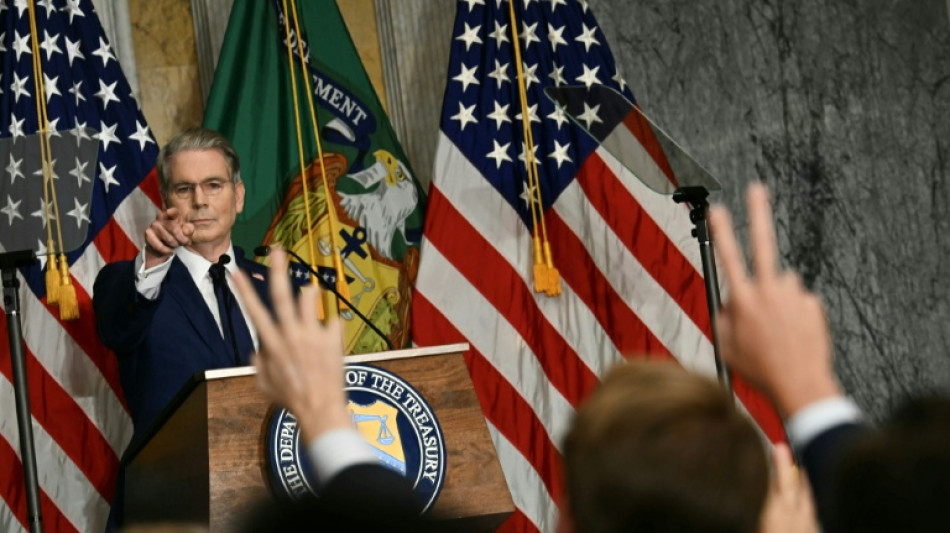
China is among countries whose entities have already been hit by the sweeping US plan, with Treasury Secretary Scott Bessent telling Beijing to "get with the programme".
But Beijing instead has defended its cooperation with Tehran and vowed to safeguard its interests.
The apparent impasse is likely to further strain ties between Beijing and Washington, ahead of an expected visit by China's President Xi Jinping to the US capital in September.
- Oil 'central lever' -
Iran has weathered sanctions for decades, using complex international financial networks to evade restrictions.
Cutting off Iran "would certainly require China's help", said political scientist Dylan Loh of Singapore's Nanyang Technological University.
Beijing is a key customer for Iranian oil, while "a good amount of their trade also relies on (the Chinese currency) renminbi, which can be outside the reach of US sanctions", Loh told AFP.
Before the war, Tehran exported millions of barrels of oil a day, mostly to China.
"Oil is the central economic lever," said Nino Lezhava, a fellow at the Washington-based Center for European Policy Analysis.
Although most ship traffic in the vital Strait of Hormuz is still blocked, China is not totally cut off from Iran's crude thanks to the highways and railways of Central Asia, said Sun Degang, a professor of political science at Shanghai's Fudan University.
Despite Chinese purchases being lower than before, they remain an important source of revenue.
"Simply continuing to... maintain commercial channels and provide alternative payment mechanisms can substantially reduce the effectiveness of economic isolation," said Lezhava.
- 'Economic sovereignty' -
The United States is well aware of this.
Bessent said "no one is above the reach of US sanctions" when asked if Washington would target Chinese banks that do business with Iran.
However, while its sanctions announced on Monday targeted some Chinese entities accused of helping Tehran procure "critical technology", Washington has so far held back from punishing major Chinese financial institutions.
The United States "can't expect to obtain China's support if it continues to implement sanctions on Chinese companies", said Fudan University's Sun.
"Sino-Iranian trade relations are legitimate and China will safeguard its economic sovereignty."
China is already feeling some consequences from the Strait of Hormuz disruption, adding to economic strain from persistently sluggish domestic consumption.
Cutting off Iran would exacerbate that, as well as implicate Beijing in a messy conflict that has already weakened its strategic rival Washington.
Overall, China has "little reason" to cooperate with the United States on sanctions, said Chong Ja Ian, an associate professor of political science at the National University of Singapore.
- 'Push back' -
On Tuesday, China's foreign ministry said its cooperation with Iran has "always been conducted within the framework of international law and should not be interfered with or disrupted".
Chong said that "Beijing seems highly confident of its ability to push back successfully against the US", were it pressured.
China has expanded its capacities to deal "precisely with such scenarios", said Loh.
"China has its own tools to respond to protect its own interest as we have seen in the tit-for-tat export controls," he added.
China and the United States spent much of last year embroiled in an escalating trade war but reached a fragile truce when the two presidents met last October.
A successful global campaign against Iran may require Washington "to provide incentives" to Beijing to join it, said Lim Tai Wei, a professor and East Asia expert at Japan's Soka University.
China would only cooperate "if the costs of supporting Iran became significantly higher than the strategic and economic benefits", said Lezhava.
E.Becker--BP