Carney poised to win Canada majority but affordability pressure looms / Photo: © AFP
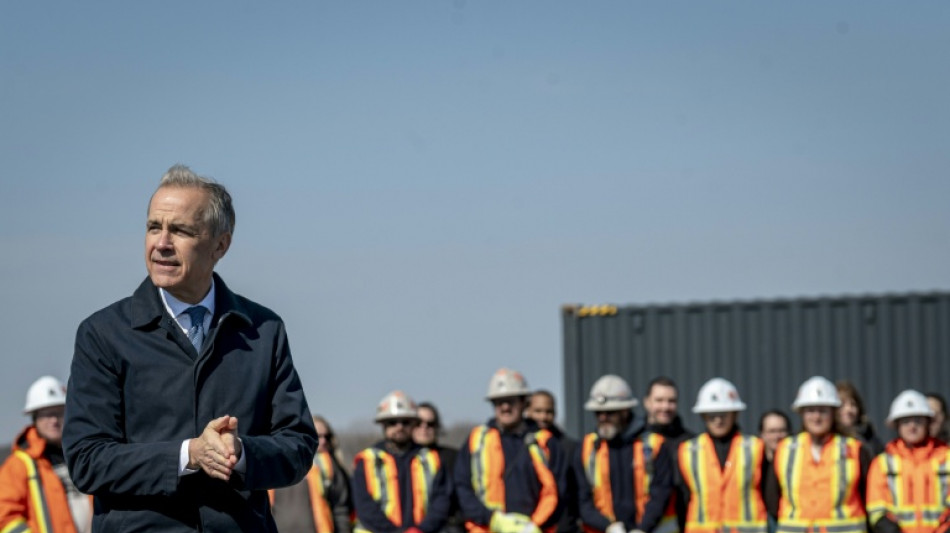
Canadian Prime Minister Mark Carney's Liberal Party is poised to secure a majority in parliament in by-elections Monday, but a year into his tenure, hints of vulnerability may be emerging.
A string of recent polls put the Liberals more than 10 points ahead of the opposition Conservatives.
But on a bright chilly morning in a Toronto area -- one of three districts holding special elections next week to fill parliamentary seats -- some said Carney's sparkling credentials had not delivered tangible results.
"He talks a good game but nothing ever changes," said David Gilhooly, 52, who had a long, thick beard and wore a heavy coat as the Canadian winter dragged into April.
Carney led the central banks of Canada and Britain before replacing Justin Trudeau as prime minister in March 2025.
Voters had soured on the Liberals after Trudeau's decade in power and the party was headed for an electoral wipeout.
But Carney transformed the race, persuading Canadians he was the ideal leader to confront the trade conflicts and geopolitical turmoil triggered by US President Donald Trump.
Carney's Liberals won elections last April but fell just short of a majority.
He has since delivered a series of speeches warning that Canada needs to dramatically reduce its economic and security dependence on the United States, arguing Trump's presidency had caused a "rupture" in the world order.
The prime minister has announced massive military spending increases and sought new trade deals in Europe and Asia.
The Liberals have also poached five opposition lawmakers to join their caucus.
The stunning defections mean if the Liberals win in two of the three districts holding by-elections Monday, they will take full control of parliament.
Two of those districts, both in Toronto, are seen as safe Liberal seats.
- 'Slick guy' -
Gilhooly volunteers at a center that supports people struggling with addiction and homelessness, in a central Toronto area that has for decades been home to waves of immigrant groups.
The district was previously represented by former deputy prime minister Chrystia Freeland, who left Canadian politics to work for Ukrainian President Volodymyr Zelensky.
Gilhooly sees Carney as a "slick guy" comfortable in "nice suits."
But "what are you actually offering on the ground level?" he asked. "I don't think things are getting better."
Public surveys support his critique.
The Angus Reid Institute found last month that while the Liberals maintain an eight-point lead over Conservatives (44 to 36 percent), "concerns over the high cost of living are higher than they have been in recent memory for lower-income Canadians."
Grocery prices are up more than 20 percent since 2022 and unemployment is at 6.7 percent, an elevated number caused partly by Trump's tariffs.
More than 40 percent of Canadians told Angus Reid they were feeling medium or high levels of financial pressure over issues like food prices and personal debt. That group of voters is far less likely to vote Liberal, the poll found.
- 'Critical disconnect' -
The Conservatives are hammering Carney over what they say is his failure to turn rhetoric about economic transformation into relief.
Serena Purdy is the by-election candidate for the left-wing New Democrats in the central Toronto district.
The Liberals have comfortably won the seat in three straight votes and should hold it on Monday.
But Purdy, sitting in a park flanked by row houses, shops and cafes in a historic market area, told AFP that after weeks of knocking on doors she eyes an opportunity.
"I see a critical disconnect between the day-to-day lives of people" and federal policy, she said.
"We're building momentum."
But the Liberals remain a political juggernaut for now.
A Nanos poll from last week shows them leading the Conservatives by 15 points. In head-to-head leadership surveys, Carney trounces Conservative leader Pierre Poilievre.
"I don't recall any period in the past where the popularity of the incumbent prime minister has shot up so quickly and so profoundly a year after an election," said Nelson Wiseman, an emeritus politics professor at the University of Toronto.
C.Stein--BP