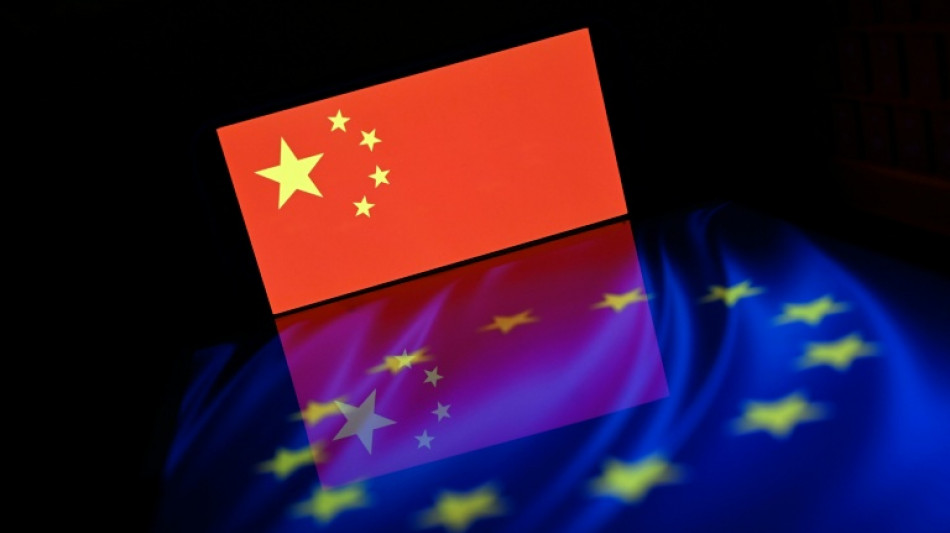
EU wrestles over how to tackle China export flood / Photo: © AFP/File
EU leaders will grapple on Thursday over whether the bloc needs new beefed-up trade defences to curb the surge of Chinese exports deemed an existential threat to European industry and jobs by Brussels.
There is a growing consensus in the European Union that it is too dependent on China, and Brussels fears this makes it vulnerable to potential coercion and supply shocks.
The bloc's trade deficit in goods hit around 360 billion euros ($417 billion) last year, meaning Chinese exports sharply exceeded the EU's.
"Our trading relationship with China has reached a point that requires a reset. Not confrontation, but rebalancing," EU trade chief Maros Sefcovic said.
While EU capitals agree on a common diagnosis on China, the positions differ on the cure.
One way to beef up the EU's arsenal could be creating a new tool to impose sector-specific tariffs such as chemicals or green tech -- taking a page out of President Donald Trump's playbook.
French President Emmanuel Macron last month called for a "European equivalent of Section 301" -- the trade tool Trump has employed to set sweeping tariffs -- arguing Europe's "sovereignty is at stake".
Germany has until now adopted a cautious posture because its economy is more exposed to potential retaliation, while Spain has sought to avoid tensions as it chases Chinese investment.
But Berlin appeared to be coming around to France's way of thinking.
A German official said Berlin was "open" to new tools if they are necessary so long as they were "not targeted at specific recipients".
Concern about Chinese dominance is not limited to the EU.
Fears are rising in the West over Beijing's control in the market for rare earth minerals used in everyday electronic appliances, and China was on the menu during talks between G7 leaders in France this week.
The real wake-up call came last year when China imposed export controls on rare earths, sending shockwaves across supply chains globally.
- China's massive subsidies -
Brussels often evokes the need for fair competition, pointing to the unfair advantage Chinese companies have because of massive state subsidies.
Between 2005 and 2024, Chinese firms received around three to eight times more government support than firms in the Organisation for Economic Co-operation and Development, according to the OECD, which called it "a conservative estimate".
Over dinner, the leaders will chew over what current tools the EU can use to address the imbalance and whether there should be new instruments and actions, which the European Commission has stridently pushed for.
The discussion will reveal just how far the EU will go to protect its industries, with leaders due to guide the commission on its next steps.
"There may be a member state or two who are more cautious," an EU diplomat said, but he said the majority see "the situation the same way".
"We have to be ready to do more," he said.
The commission, in charge of EU trade policy, is also mulling whether to introduce safeguard measures for the chemicals industry, like it did for steel.
- EU appetite for a fight? -
Even as its resolve appears to be hardening, the EU has showed no appetite to trigger a broader trade war with China.
Fears over Chinese retaliation are not unfounded.
After the EU hit Chinese electric cars with higher tariffs in 2024, China imposed anti-dumping duties on European cognac.
And Beijing has vowed to retaliate if the EU pushes through rules that would exclude certain products manufactured outside the bloc from public contracts.
Sefcovic has invited Chinese Commerce Minister Wang Wentao to Brussels later this month as the bloc still hopes it can prevent escalation through dialogue with China -- but an EU official would not confirm the visit.
K.Lehmann--BP