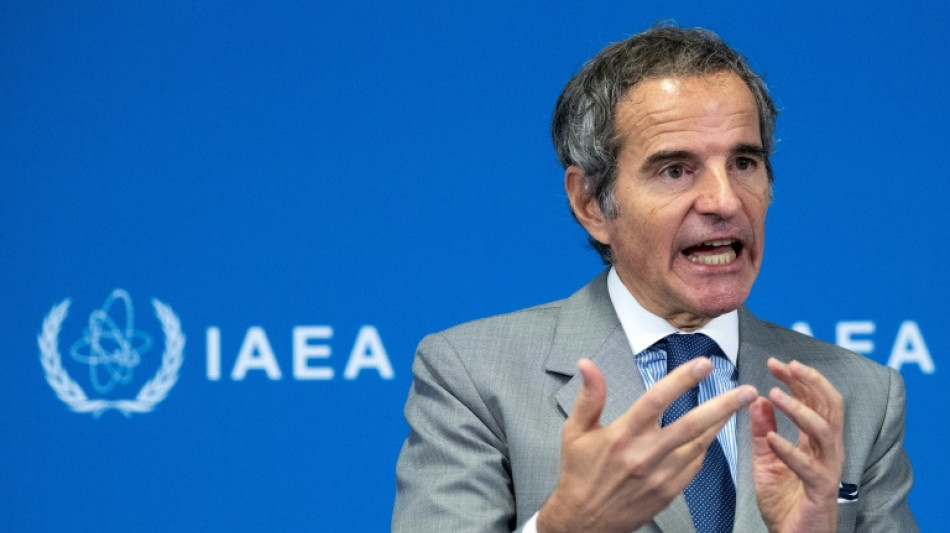
IAEA ready to help define 'concrete steps' to implement US-Iran deal / Photo: © AFP
The International Atomic Energy Agency said Thursday that it was ready to begin defining the "concrete steps" needed to implement a US-Iran deal to end the Middle East war.
US President Donald Trump and Iranian President Masoud Pezeshkian signed a deal Wednesday meant to end the Middle East war, with Tehran agreeing to dilute its enriched uranium in return for large-scale economic relief.
"Now it's for us to sit down with our American colleagues, our Iranian colleagues, and start formulating the concrete steps that will have to be taken," IAEA chief Rafael Grossi told reporters in Geneva.
The deal aims to draw a line under the war launched by the United States and Israel February 28, prompting Iran to counter-attack with missile and drone salvos across the region -- and effectively shutting down the Strait of Hormuz, a crucial waterway for the world economy.
Washington responded by blocking shipping to and from Iranian ports.
Under the terms of the deal released by US officials, Iran will dilute its enriched uranium stocks, possibly by "down-blending on site under the supervision of the IAEA", the UN's nuclear watchdog.
"This is a very complex operation and it's not a secret so we will have to be very, very detailed," Grossi said, adding that the outcome would depend "on the political will of both sides".
"Anything can work when two sides decide that they want something to be done," he said, adding that they were looking to his organisation to tell "them what is needed".
- 'Impartial' -
The IAEA estimates that Iran had 440 kilogrammes of uranium enriched to 60 percent -- close to the level needed for a bomb -- as Israel and the United States launched their first attacks in June last year.
Iran suspended cooperation with the IAEA then and inspectors have not seen the material since.
The UN nuclear watchdog's governing board last week approved a Western resolution demanding that Iran immediately provide information and access to its uranium stockpile and production facilities.
Tehran slammed that resolution as "counter-productive" at a time when talks were going on, and charged it was "politically-motivated" -- something Grossi vehemently denied.
"The work of the IAEA is an impartial, technical work," he said.
"The fact that in this memorandum of understanding that has been signed, the indispensable role of the IAEA is recognised... it says it all in terms of our credibility and the indispensable role we have to play."
The agreement is only a temporary arrangement meant to give time for starting detailed negotiations on the far more complex issue of long-term control over Iran's nuclear power ambitions, which Washington has long suspected of harbouring a secret bomb-making programme.
"I think it's good that the memorandum is there," Grossi said.
"Now the technical work starts."
Y.Bauer--BP