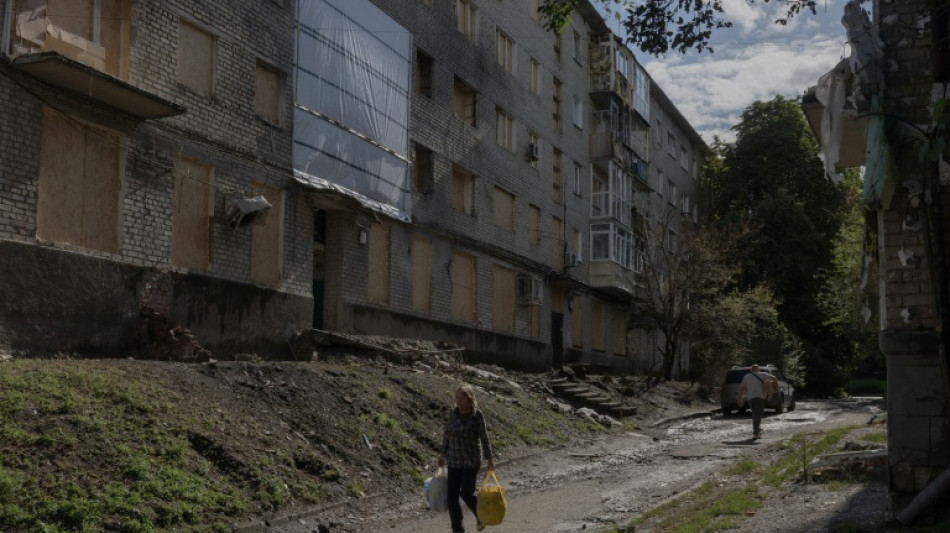
Ukrainians seeking beauty in a bomb-scarred city / Photo: © AFP
The Ukrainian city of Izyum has been splintered by Russian bombs -- but 21-year-old Violetta Dezhyna's job is to find beauty in those broken places and help keep the city alive, even as Russia advances once more.
In dusty streets teeming with men in camouflage and scattered with wrecked military vehicles she scours for scenes of normality to post on the city social media pages.
Pruned flowerbeds stand in front of gutted and mangled apartment blocks.
"Here the buildings are destroyed, not pretty. Here, it seems, there's a fountain, but on the other side there's a ruined building," said Dezhyna, who works for the local admimistration.
"I try to find angles where those things aren't visible."
Russia's army captured Izyum, the gateway to Ukraine's eastern Donbas region -- a key target for Russian President Vladimir Putin -- at the start of its 2022 invasion, occupying it for six months before Ukraine retook control.
The majority of Izyum's pre-invasion population of 45,000 came back after Russian troops were pushed back some 60 kilometres (36 miles) in a lightning Ukrainian counter-offensive in autumn 2022.
Dezhyna, then a teenager, returned with her family to help "rebuild" the wounded city.
But the battles have left deep scars on Izyum and its residents -- both physical and psychological.
Months of grinding advances have brought the Russian troops to within 30 kilometres (18 miles) of Izyum again.
And Dezhyna is watching many of her young friends leave once more.
- Lip gloss and anti-drone nets -
To be around people and feel a sense of community, she frequents the local gym.
Hidden in the basement of a supermarket, the thick smell of sweat hangs heavy in the air as she pushes weights alongside bearded muscle-men.
In between sets, she chats casually with soldiers and their wives -- many more than twice her age.
Over the echo of nearby explosions, they sometimes play beach volleyball near the river -- "the most beautiful place in town".
Back in the office, cracks in the walls and aluminium tape over the windows -- to stop glass shards flying into the building in case of an explosion -- reveal the constant danger faced by those in the city.
Another worker -- also a young women, with blue hair -- took out a small mirror, applied lip gloss then lifted her eyes to the window: taking in the sight of anti-drone nets that engulf the city's buildings and roads.
- Violins and sirens -
In another official building across town, violin notes mixed with air raid sirens.
Tamara Georgina, 58, was preparing the room for an upcoming wedding.
"This is resistance ... to spite the enemy. We work, we live, we show that we're not surrendering. This is our town and we're rebuilding it," she told AFP.
Behind her the groom, a soldier, quickly answered his phone.
An incoming missile.
"It's not heading to us," he muttered.
The ceremony can begin.
Residents say many buildings in the city are "marked" -- a term meaning they are a known target for the Russian army.
They include many places where young people typically gather, like the city's Palace of Culture.
Some still kill time in the ruins of what was once a city landmark -- vaping amid the smell of urine.
Dezhyna, who leaves a faint floral scent behind her as she paces the streets, is lobbying officials to rebuild a skate park.
If young people leave, "there will be no future at all," she said.
"I want our community to thrive. I don't want it to remain ... grey."
- Prom dresses and invasions -
Roughly 2,000 children still live in Izyum.
School activities -- transformed by the war into classes such as "emotional resilience" -- take place in the building's basement.
Classes for Dezhyna -- then in her final year -- were cancelled on February 24, 2022, the day Russia invaded.
Her prom dress was supposed to arrive the next day.
"I can't say the feelings are very good," she said, walking through her old classroom, chairs now covered in dust.
Russian troops had used it as a base during their occupation of the city.
With them inching closer to the city, Dezhyna and her parents are again thinking about whether they should flee to refuge, far from her beloved Izyum.
"We have to think about it, but I don't want to," she said.
"It will be a one-way trip."
T.Schmid--BP