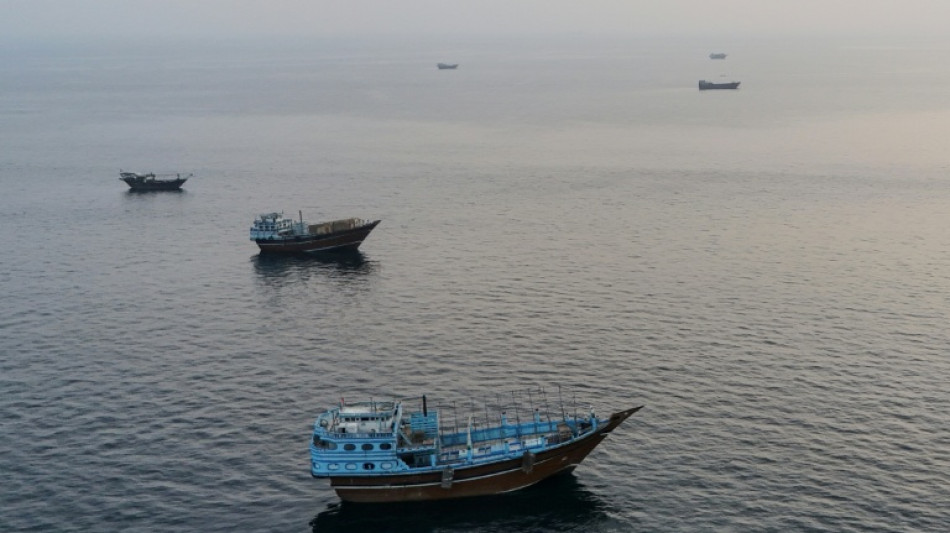
Iran says US sanctions will achieve nothing / Photo: © AFP/File
Iran's president insisted on Wednesday that the United States would achieve nothing with its new sanctions campaign after Washington laid out plans to collapse the country's economy.
Almost six months into their war, the two sides are locked in a stalemate, with Iran keeping the key Strait of Hormuz shut and Washington persisting with a naval counter-blockade of Iran.
Under political pressure at home over the impacts of the conflict, US President Donald Trump has pivoted away from military action to economic levers, expanding sanctions and warning of consequences for countries that do not join.
But Iran -- which has already weathered decades of sanctions -- has remained defiant, with officials saying they have a two-year plan to counter the pressure.
"America will not achieve anything with economic pressure at this stage, just as it was unable to achieve anything in the war," Iranian President Masoud Pezeshkian said Wednesday, according to the country's ISNA news agency.
"We will stand firm against economic pressures, as we have done so far and will continue to do."
Iranian army spokesperson Mohammad Akraminia, meanwhile, told state television Wednesday that the military had restored its combat capabilities degraded during the war, with the reconstruction of all damaged weapons systems and the import of new equipment from abroad.
On Monday, US Treasury Secretary Scott Bessent had claimed the US had "dismantled Iran's military capabilities, destroyed nearly 100 percent of its military factories, and buried its nuclear programme".
Announcing the new economic measures, Bessent said expanded secondary sanctions would target Iran's digital assets and its technology, gold, aviation and shipping sectors.
- 'Not in a hurry' -
The US and Israel launched the war against Iran in late February, vowing to end an alleged Iranian nuclear weapons programme and threatening to topple the regime in Tehran.
Iran -- which has long denied pursuing a nuclear bomb -- responded with barrages of missiles and drones targeting US allies in the Gulf and closing the Strait of Hormuz, a vital shipping route for global supplies of oil and gas.
The waterway's closure has strained the world economy as shipments fail to reach major markets, pushing up the price of oil and placing pressure on Trump ahead of mid-term elections in November.
Trump had frequently claimed a deal was close, but has since backed away from diplomacy.
"I have no time schedule, none. I'm not in a hurry. I have no time schedule at all," Trump told news outlet Al Jazeera on Wednesday when asked how much time he was giving Iran for talks.
Israeli Prime Minister Benjamin Netanyahu on Tuesday dismissed any prospect of a deal.
"I tell you -- an agreement cannot be reached," he said, calling Iran's leaders "savages".
- 'Total control' -
In recent weeks, the conflict has come to revolve around the blockaded Strait of Hormuz. Iran says it will not reopen the vital waterway until the US meets its demands, and has frequently attacked vessels trying to cross.
Tehran has also indicated it intends to impose fees for use of the strait, which the US and others in the region fiercely oppose.
Trump insists the US navy has "total control" of the strait and has even called it US territory, but traffic there remains at a fraction of pre-war levels.
Oman, which sits on the other side of Hormuz from Iran, has been discussing with Tehran a temporary transit corridor to enable traffic to resume.
On Wednesday, Iran's Revolutionary Guards, the ideological arm of its military, said the talks with Oman included the two countries agreeing to share any revenues collected from management of the strait, accusing the US of "obstructing work" to finalise the deal.
Omani Foreign Minister Badr Albusaidi said on Tuesday that he hoped his country and Iran would "soon announce" the temporary corridor.
Iranian Deputy Foreign Minister Kazem Gharibabadi, in an interview with local media, said if the temporary route was agreed, Iran and Oman would have between 30 and 60 days to negotiate a permanent route to replace it.
He added that the Guards were involved in the talks and that the maps under discussion were drawn up by the armed forces.
burs-axn/jfx/smw
U.Schmid--BP