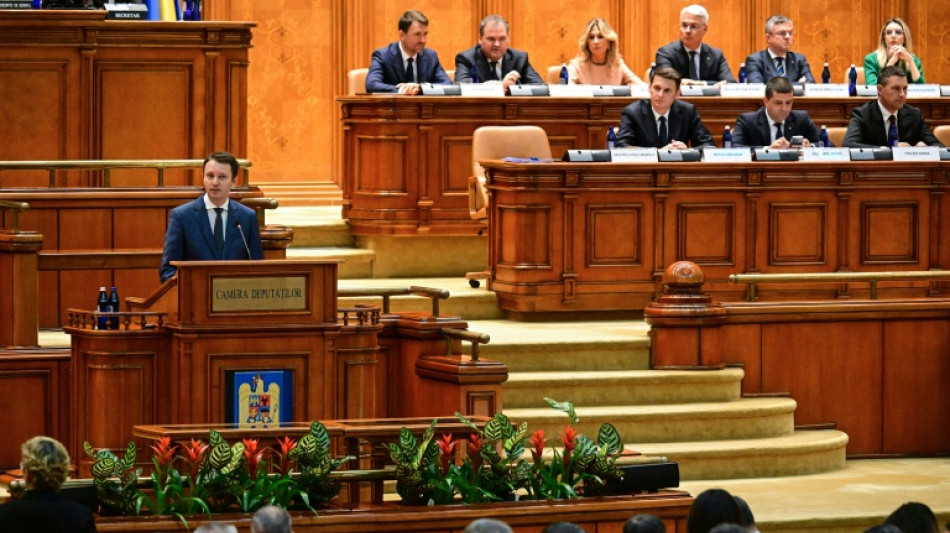
Romanian parliament rejects pro-EU PM candidate amid political deadlock / Photo: © AFP
The Romanian parliament on Wednesday rejected a pro-European liberal as prime minister, prolonging a political crisis seen as fuelling an already rising far right.
Liberal European Parliament member Siegfried Muresan failed to get lawmakers' backing with just 182 of the 233 votes needed to approve his government, according to the official count.
This brings the prospects of snap elections closer, but pro-EU President Nicusor Dan has warned those would not solve the crisis facing the eastern European country.
A pro-European coalition government collapsed in May when the governing Social Democrats, together with the opposition far right, ousted liberal Prime Minister Ilie Bolojan.
Since then, president Dan has nominated three candidates for the post of prime minister but all failed to form government, with the latest being Muresan.
- 'Reform agenda' -
Muresan, 45, had promised a pro-EU cabinet with "an ambitious reform agenda".
As the parliament's plenary session began on Wednesday, Muresan said the choice was between "a Romania that moves forward and one that stands still", between "reform and preserving the status quo".
But analysts had said Muresan's chances were slim as the centre-left Social Democratic Party (PSD), the largest party, has refused to back him, demanding the premiership for itself.
The main far-right party, the Alliance for the Union of Romanians (AUR), also said they would not vote for Muresan.
"Despite all the threats, we will not vote for this puppet government," AUR leader George Simion said on Wednesday in parliament ahead of the vote.
Currently the country's second biggest party, AUR is leading in two recent voter opinion polls, one at almost 40 percent, the other at 36 percent.
The current crisis was sparked when the PSD, which holds 129 seats in parliament, quit the ruling coalition over austerity measures taken by Bolojan and teamed up with the far right to oust him.
President Dan has accused the political parties of showing "more concern for electoral matters and far less concern for the national interest".
- Rising far right -
The far right -- which comprises roughly a third of parliament -- has threatened to impeach Dan if he does not call early elections once the conditions are met.
Romania -- a member of the EU and NATO that borders Ukraine -- has not held snap elections since the fall of Communism in 1989.
Political analyst Cristian Pirvulescu told AFP he expected Dan to end up choosing another candidate for prime minister -- possibly a technocrat -- before resorting to snap elections which, he predicted, would lead to another fragmented parliament but with an emboldened far right.
"Early elections mean that, from the moment they are called, it would take four months before a new government could be formed," Pirvulescu toldAFP.
"Due to political instability, Romania finds itself in a very complicated economic situation. Four months is already a very long time."
The country of 19 million has been struggling for months with the highest public deficit and inflation in the European Union.
In August, credit rating agencies said Romania's outlook remained negative because the political crisis brought a risk that deficit-cutting reforms would lose momentum.
Romania has faced heightened political uncertainty since December 2024, when the presidential election was annulled over allegations of Russia interfering on behalf of far-right candidate Calin Georgescu.
Dan won a rerun of the presidential vote in May 2025, beating AUR leader Simion.
D.Meyer--BP